Filters
Question type

Study Flashcards

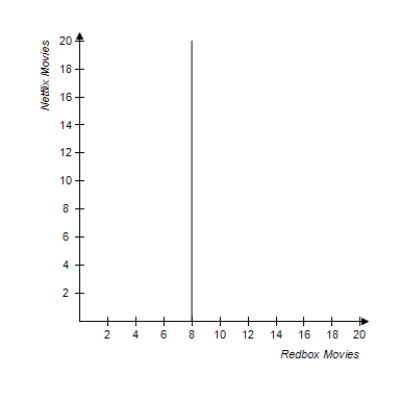
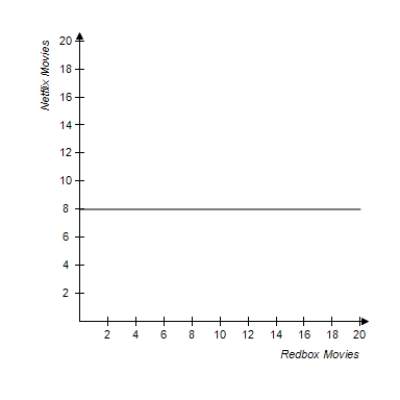
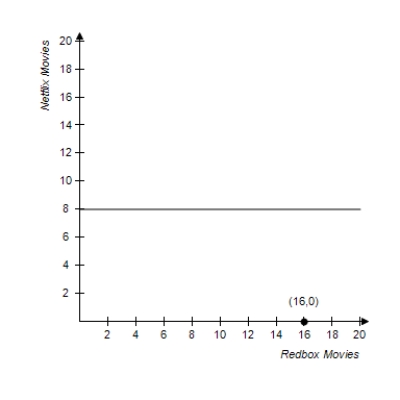
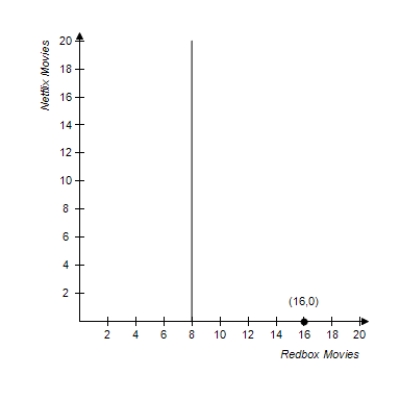
Suppose an individual is choosing between Netflix and Redbox movies. He has $16 a month to spend on movies. The price of a Redbox movie is $1 while Netflix offers unlimited movies for a monthly fee of $8. Which of the following represents this individual's budget line?


A) ​ Suppose an individual is choosing between Netflix and Redbox movies. He has $16 a month to spend on movies. The price of a Redbox movie is $1 while Netflix offers unlimited movies for a monthly fee of $8. Which of the following represents this individual's budget line? A) ​   B) ​   C) ​   D) ​
B) ​ Suppose an individual is choosing between Netflix and Redbox movies. He has $16 a month to spend on movies. The price of a Redbox movie is $1 while Netflix offers unlimited movies for a monthly fee of $8. Which of the following represents this individual's budget line? A) ​   B) ​   C) ​   D) ​
C) ​ Suppose an individual is choosing between Netflix and Redbox movies. He has $16 a month to spend on movies. The price of a Redbox movie is $1 while Netflix offers unlimited movies for a monthly fee of $8. Which of the following represents this individual's budget line? A) ​   B) ​   C) ​   D) ​
D) ​ Suppose an individual is choosing between Netflix and Redbox movies. He has $16 a month to spend on movies. The price of a Redbox movie is $1 while Netflix offers unlimited movies for a monthly fee of $8. Which of the following represents this individual's budget line? A) ​   B) ​   C) ​   D) ​

E) B) and C)
F) All of the above

Correct Answer

verifed

verified

Higher education is a normal good. If its price falls,


A) the quantity demanded of higher education will fall.
B) the substitution and income effects work in opposite directions.
C) the income effect is positive.
D) higher education will be a Giffen good.

E) A) and D)
F) B) and C)

Correct Answer

verifed

verified

When Joshua's income increases, he purchases more prime-rib dinners than he did before his income increased. For Joshua, prime-rib dinners are a(n)


A) normal good.
B) inferior good.
C) optimal good.
D) Giffen good.

E) None of the above
F) C) and D)

Correct Answer

verifed

verified

If goods X and Y are both normal goods for Brenda, then an increase in Brenda's income will lead her to __________.

Correct Answer

verifed

verified

buy more o...

View Answer

Scenario 21-2 Lawrence has recently graduated from college with a degree in journalism and economics. He has decided to pursue a career as a freelance journalist writing for business newspapers and magazines. Lawrence is typically awake for 112 hours each week (he sleeps an average of 8 hours each day) . For each hour Lawrence spends writing, he can earn $75. Lawrence is such a good writer that he can get paid for as many hours of writing as he chooses to work. -Refer to Scenario 21-2. If Lawrence decides to spend 80 hours a week playing volleyball on the beach and the rest of his time writing, how much income will he have available to spend on consumption goods?


A) $900
B) $1,500
C) $2,400
D) $3,000

E) None of the above
F) B) and C)

Correct Answer

verifed

verified

Which of the following is not a property of a typical indifference curve?


A) downward sloping
B) bowed away from the origin
C) does not intersect another indifference curve
D) a higher one is preferred to a lower one

E) B) and C)
F) A) and C)

Correct Answer

verifed

verified

Scenario 21-3 Scott knows that he will ultimately face retirement. Assume that Scott will experience two periods in his life, one in which he works and earns income, and one in which he is retired and earns no income. Scott can earn $250,000 during his working period and nothing in his retirement period. He must both save and consume in his work period with an interest rate of 10 percent on savings. -Refer to Scenario 21-3. If the interest rate on savings increases, it is possible that


A) Scott will decrease his savings in the work period.
B) Scott will increase his savings in the work period.
C) Scott will not change his consumption in the work period.
D) All of the above are possible.

E) C) and D)
F) B) and C)

Correct Answer

verifed

verified

If an increase in the interest rate lowers savings, then


A) the substitution effect is greater than the income effect.
B) the income effect is greater than the substitution effect.
C) the income effect and the substitution effect move in the same direction.
D) we are unable to determine the sizes of the income and substitution effects without more information.

E) None of the above
F) All of the above

Correct Answer

verifed

verified

Figure 21-22 Figure 21-22   -Refer to Figure 21-22. If the consumer were initially at point A in the figure, a movement from point B to point C as a result of a decrease in the price of potato chips represents the A) substitution effect. B) income effect. C) budget effect. D) price effect. -Refer to Figure 21-22. If the consumer were initially at point A in the figure, a movement from point B to point C as a result of a decrease in the price of potato chips represents the


A) substitution effect.
B) income effect.
C) budget effect.
D) price effect.

E) A) and C)
F) A) and B)

Correct Answer

verifed

verified

Pete consumes two goods, rice and fish. When the price of fish rises, he consumes less fish. When the price of rice rises, he consumes more rice. For Pete,


A) fish is not a Giffen good but rice is.
B) rice is not a Giffen good but fish is.
C) both fish and rice are normal goods.
D) both fish and rice are Giffen goods.

E) B) and C)
F) B) and D)

Correct Answer

verifed

verified

A consumer consumes two normal goods, popcorn and Pepsi. The price of Pepsi rises. The substitution effect, by itself, suggests that the consumer will consume


A) more popcorn and more Pepsi.
B) less popcorn and less Pepsi.
C) more popcorn and less Pepsi.
D) less popcorn and more Pepsi.

E) All of the above
F) A) and C)

Correct Answer

verifed

verified

When we draw Katie's indifference curves to represent her preferences for books and movies, we find that her indifference curves are upward-sloping. What does this tell us about Katie's preferences?

Correct Answer

verifed

verified

Either Katie dislike...

View Answer

Figure 21-7 Figure 21-7   -Refer to Figure 21-7. Suppose the price of a book is $15, the price of a DVD is $10, the value of A is 5, and the value of B is 7.5. How much income does the consumer have? A) $150 B) $100 C) $75 D) $37.50 -Refer to Figure 21-7. Suppose the price of a book is $15, the price of a DVD is $10, the value of A is 5, and the value of B is 7.5. How much income does the consumer have?


A) $150
B) $100
C) $75
D) $37.50

E) C) and D)
F) None of the above

Correct Answer

verifed

verified

Which of the following is a property of a typical indifference curve?


A) upward sloping
B) bowed away from the origin
C) does not intersect another indifference curve
D) a higher one is preferred to a lower one

E) C) and D)
F) A) and C)

Correct Answer

verifed

verified

Suppose at the consumer's current consumption bundle the marginal rate of substitution of cheese for wine is 1/2 bottle of wine per pound of cheese. The price of one pound of cheese is $6, and the price of a bottle of wine is $10. The consumer should increase his consumption of


A) cheese, decrease his consumption of wine, and move to a lower indifference curve.
B) cheese, decrease his consumption of wine, and move to a higher indifference curve.
C) wine, decrease consumption of cheese, and move to a higher indifference curve.
D) cheese, decrease consumption of wine, and remain on the same indifference curve.

E) A) and B)
F) C) and D)

Correct Answer

verifed

verified

At the consumer's optimum


A) the budget constraint will have a slope of MUx/Px.
B) it is still possible for the consumer to increase his consumption of both goods.
C) the indifference curve will intersect the budget constraint at the midpoint of the budget constraint.
D) the slope of the indifference curve is equal to the slope of the budget constraint.

E) A) and C)
F) All of the above

Correct Answer

verifed

verified

Figure 21-19 Figure 21-19   -Refer to Figure 21-19. Assume that the consumer depicted in the figure has an income of $50. The price of Skittles is $5 and the price of M&M's is $5. This consumer will choose a consumption bundle where the marginal rate of substitution is A) 10. B) 5. C) 1. D) 1/5. -Refer to Figure 21-19. Assume that the consumer depicted in the figure has an income of $50. The price of Skittles is $5 and the price of M&M's is $5. This consumer will choose a consumption bundle where the marginal rate of substitution is


A) 10.
B) 5.
C) 1.
D) 1/5.

E) B) and C)
F) All of the above

Correct Answer

verifed

verified

Figure 21-12 Figure 21-12   -Refer to Figure 21-12. If the consumer moves from bundle W to bundle Z, the A) marginal rate of substitution remains constant. B) total utility remains constant. C) total utility decreases. D) Both a)  and b)  are correct. -Refer to Figure 21-12. If the consumer moves from bundle W to bundle Z, the


A) marginal rate of substitution remains constant.
B) total utility remains constant.
C) total utility decreases.
D) Both a) and b) are correct.

E) A) and C)
F) All of the above

Correct Answer

verifed

verified

Explain the difference between inferior and normal goods. As a developing economy experiences increases in income (measured by GDP), what would you predict to happen to demand for inferior goods?

Correct Answer

verifed

verified

Normal goods are those for which consump...

View Answer

If Walter has one hour of leisure time in which to watch a sporting event on television, his preferences are as follows: Walter prefers watching football to watching baseball, but he prefers watching baseball to watching basketball. He is indifferent between watching baseball and watching hockey. Bundle A contains one hour of football and zero hours of all other sports. Bundle B contains one hour of baseball and zero hours of all other sports. Bundle C contains one hour of basketball and zero hours of all other sports. Bundle D contains one hour of hockey and zero hours of all other sports. If we were to graph Walter's preferences using indifference curves, which of the following bundles would be on the same indifference curve?


A) A, B, and C only
B) B and D only
C) A and D only
D) There is no combination of the sports that could be drawn on the same indifference curve.

E) A) and B)
F) A) and C)

Correct Answer

verifed

verified

Showing 461 - 480 of 568

Related Exams

Show Answer