A) increase foreign bond purchases, so the dollar appreciates.
B) increase foreign bond purchases, so the dollar depreciates.
C) increase domestic bond purchases, so the dollar appreciates.
D) increase domestic bond purchases, so the dollar depreciates.
F) C) and D)
Correct Answer

verified
Correct Answer
verified
A) right as do increases in government spending.
B) right while increases in government spending shift aggregate demand left.
C) left as do increases in government spending.
D) left while increases in government spending shift aggregate demand right.
F) B) and D)
Correct Answer
verified
Correct Answer
verified
A) to A in the long run.
B) to C in the long run.
C) back to A in the long run.
D) to D in the long run.
F) C) and D)
Correct Answer
verified
Correct Answer
verified
A) aggregate demand right.
B) aggregate demand left.
C) aggregate supply right.
D) aggregate supply left.
F) None of the above
Correct Answer
verified
Correct Answer
verified
A) 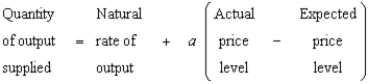
B) 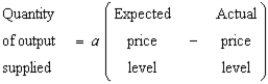
C) 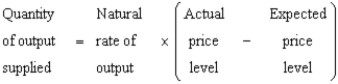
D) 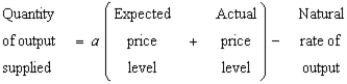
F) None of the above
Correct Answer
verified
Correct Answer
verified
A) both price and real GDP are higher.
B) both price and real GDP are lower.
C) the price level is the same and GDP is lower.
D) the price level is lower and real GDP is the same.
F) A) and C)
Correct Answer
verified
Correct Answer
verified
Correct Answer
verified
The price level decr...View Answer
Correct Answer
verified
View Answer
A) Congress reduces purchases of new weapons systems.
B) The Fed buys bonds in the open market.
C) The price level falls.
D) Net exports fall.
F) A) and D)
Correct Answer
verified
Correct Answer
verified
A) declining inflation expectations.
B) an increase in oil prices.
C) declines in the price of stock.
D) decreases in the money supply.
F) B) and C)
Correct Answer
verified
Correct Answer
verified
A) technology improves.
B) the price level decreases.
C) the money supply increases.
D) All of the above are correct.
F) B) and D)
Correct Answer
verified
Correct Answer
verified
A) as people revise their price-level expectations upward, firms and workers strike bargains for higher nominal wages.
B) as people revise their price-level expectations upward, firms and workers strike bargains for lower nominal wages.
C) as people revise their price-level expectations downward, firms and workers strike bargains for higher nominal wages.
D) as people revise their price-level expectations downward, firms and workers strike bargains for lower nominal wages.
F) B) and D)
Correct Answer
verified
Correct Answer
verified
A) relative to prices wages are higher and employment rise.
B) relative to prices wages are higher and employment falls.
C) relative to prices wages are lower and employment rises.
D) relative to prices wages are lower and employment falls.
F) C) and D)
Correct Answer
verified
Correct Answer
verified
A) rise, so domestic residents will want to hold more foreign bonds.
B) rise, so domestic residents will want to hold fewer foreign bonds.
C) fall, so domestic residents will want to hold more foreign bonds.
D) fall, so domestic residents will want to hold fewer foreign bonds.
F) B) and D)
Correct Answer
verified
Correct Answer
verified
A) employment and production rise.
B) employment rises and production falls.
C) employment falls and production rises.
D) employment and production fall.
F) None of the above
Correct Answer
verified
Correct Answer
verified
B) False
Correct Answer
verified
Correct Answer
verified
A) people want to hold more money.
B) the interest rate rises.
C) investment spending rises.
D) All of the above are correct.
F) A) and D)
Correct Answer
verified
Correct Answer
verified
A) investment.
B) unemployment.
C) tax revenues.
D) new home construction.
F) A) and D)
Correct Answer
verified
Correct Answer
verified
B) False
Correct Answer
verified
Correct Answer
verified
A) an increase in taxes
B) an increase in government expenditures
C) a decrease in the minimum wage
D) an increase in the capital stock
F) C) and D)
Correct Answer
verified
Correct Answer
verified
A) increase which shifts aggregate demand right.
B) increase which shifts aggregate demand left.
C) decrease which shifts aggregate demand right.
D) decrease which shifts aggregate demand left.
F) A) and B)
Correct Answer
verified
Correct Answer
verified
Showing 81 - 100 of 572
Related Exams