A) ratio of total utilities is equal to the relative price ratio.
B) ratio of income to price equals the marginal rate of substitution.
C) marginal rate of substitution is equal to the relative price ratio of the goods.
D) marginal rate of substitution is equal to marginal utility.
F) B) and D)
Correct Answer

verified
Correct Answer
verified
B) False
Correct Answer
verified
Correct Answer
verified
Correct Answer
verified
Yes, an increase in ...View Answer
Correct Answer
verified
View Answer
A) is currently maximizing satisfaction subject to the budget constraint.
B) could increase satisfaction by consuming more X and less Y.
C) could increase satisfaction by consuming less X and more Y.
D) could purchase more X and more Y and increase total satisfaction.
F) A) and D)
Correct Answer
verified
Correct Answer
verified
A) marginal rate of substitution equals the relative price ratio.
B) slope of the indifference curve exceeds the slope of the budget constraint.
C) ratios of all the marginal utilities are equal.
D) All of the above are correct.
F) C) and D)
Correct Answer
verified
Correct Answer
verified
A) Karen, Tara, and Chelsea
B) Karen only
C) Tara and Chelsea but not Karen
D) none of the women
F) A) and C)
Correct Answer
verified
Correct Answer
verified
A) marginal rate of substitution.
B) rate at which the consumer will give up X to gain Y while maintaining the same level of utility.
C) slope of the budget constraint.
D) All of the above are correct.
F) B) and C)
Correct Answer
verified
Correct Answer
verified
A) demand curve for milk.
B) demand curve for sandwiches.
C) supply curve for milk.
D) labor-leisure tradeoff.
F) A) and D)
Correct Answer
verified
Correct Answer
verified
A) the price of Y decreases.
B) the price of X decreases.
C) income increases.
D) All of the above would be correct.
F) All of the above
Correct Answer
verified
Correct Answer
verified
Correct Answer
verified
A pizza costs three times as m...View Answer
Correct Answer
verified
View Answer
A) a decrease in the price of X
B) an increase in the price of Y
C) a decrease in the price of Y
D) More than one of the above could explain this change.
F) A) and B)
Correct Answer
verified
Correct Answer
verified
A) remains the same.
B) shifts outward.
C) shifts inward.
D) rotates outward along the horizontal axis.
F) C) and D)
Correct Answer
verified
Correct Answer
verified
A) (i) only
B) (iv) only
C) (ii) or (iii) only
D) None of the above is correct.
F) None of the above
Correct Answer
verified
Correct Answer
verified
A) buy three times as many soccer balls as pairs of jeans.
B) buy three times as many pairs of jeans as soccer balls.
C) buy both items until the marginal utility of soccer balls is three times the marginal utility of a pair of jeans.
D) buy both items until the marginal utility of a pair of jeans is three times the marginal utility of soccer balls.
F) A) and C)
Correct Answer
verified
Correct Answer
verified
The consumer's optimum is where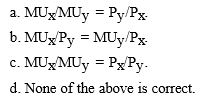
) undefined
Correct Answer
verified
Correct Answer
verified
A) an increase in the price raises the quantity demanded.
B) the income effect outweighs the substitution effect.
C) an increase in the price decreases the quantity demanded.
D) Both a) and b) are correct.
F) B) and D)
Correct Answer
verified
Correct Answer
verified
A) both the income and substitution effects encourage the consumer to purchase more of the good.
B) both the income and substitution effects encourage the consumer to purchase less of the good.
C) the income effect encourages the consumer to purchase more of the good, and the substitution effect encourages the consumer to purchase less of the good.
D) the income effect encourages the consumer to purchase less of the good, and the substitution effect encourages the consumer to purchase more of the good.
F) B) and D)
Correct Answer
verified
Correct Answer
verified
A) less while he is younger and saves more than he did before interest rates increased.
B) more while he is younger and saves more than he did before interest rates increased.
C) less while he is younger and saves less than he did before interest rates increased.
D) more while he is younger and saves less than he did before interest rates increased.
F) A) and D)
Correct Answer
verified
Correct Answer
verified
A) only partially offset by the income effect.
B) more than offset by the income effect.
C) exactly offset by the income effect.
D) We do not have enough information with which to answer the question.
F) A) and D)
Correct Answer
verified
Correct Answer
verified
A) $5
B) $10
C) $50
D) $100
F) All of the above
Correct Answer
verified
Correct Answer
verified
Showing 81 - 100 of 440
Related Exams